By: Dan McKenzie, Owner, Finish Pros. 25+ years in furniture restoration and reupholstery.
A caller described her sofa to us in about fifteen seconds and then asked what it would cost to reupholster. Fair question, and one we get every week. The honest answer was that we did not know yet, and neither did anyone else willing to give her a number over the phone.
That is not a dodge. Two sofas that look identical in a living room can quote thousands of dollars apart depending on what the frame is made of, what the springs are doing, and what fabric ends up on them. We have reupholstered pieces for $3,050 and reupholstered pieces of similar size for over $5,000, and in both cases the price was right for the work involved.
Here is what actually drives the number, with real figures from recent projects.
Quick Answer: Reupholstery Costs in Raleigh
Reupholstery labor in the Raleigh area generally runs $950 to $1,400 for a club chair, $1,450 to $1,800 for a loveseat, and $1,650 to $2,300 for a sofa. That labor includes stripping the old material off the frame.
Fabric is quoted separately. High performance upholstery materials range from about $65 per yard to well over $150, and a standard sofa in a solid fabric takes 19 to 22 yards. A useful budgetary figure is $75 per yard while you are still deciding.
Most complete sofa projects land between $2,600 and $3,400. Projects involving large scale patterns, curved frames, or dressmaker skirts can reach $5,000 or more, because those add both yardage and hours at the bench.
In short: Reupholstering a sofa in Raleigh, NC typically costs $2,600 to $3,400 total, combining $1,650 to $2,300 in labor with roughly 20 yards of fabric at $65 to $150 per yard. Club chairs start near $950 in labor and loveseats near $1,450. Frame repairs, foam replacement, and pattern matching are quoted on top, which is why an accurate estimate requires inspecting the piece rather than describing it.
We Inspect the Piece Before We Price the Labor
Our design team does not open a conversation with a labor rate. We meet with you, listen to what you want the piece to become, and then we look at the furniture itself. Four questions get answered before anything gets quoted.
Is this piece worth reupholstering at all? Sometimes the answer is no, and we say so. More on that below.
What condition is the frame in? Hardwood construction with solid joinery is worth investing in. Stapled softwood and engineered panels usually are not.
What are the springs, webbing, and padding doing? Eight way hand tied springs that need shoring up are a different job from a sagging sinuous system that needs replacing.
If repair is needed, what will it take? Most of this can be assessed without removing the existing material. Small repairs get handled as part of the upholstery process. If something major turns up once the old fabric is off, we stop and call you to talk through the options and the cost before going further, rather than quietly adding it to the invoice.
Only after those answers are in hand does pricing make sense.
The Seven Factors That Move Your Price
1. Frame condition
Loose joints, cracked dowels, and separated corner blocks all have to be corrected before new material goes on. A frame in good shape adds nothing to the quote. A frame needing structural work adds hours, and those hours are worth spending on a well built piece.
Some names tell us a lot before we look closely. Century, Baker, Rowe, Arhaus, Ethan Allen, Henredon, Stickley, and Hancock & Moore all build furniture worth investing in. When one of those comes through the door, the frame is usually the least of our concerns and the conversation moves quickly to fabric. That is not a knock on anything else. Plenty of unlabeled pieces are beautifully built, and we judge every frame on what it is rather than what it says underneath.
2. Springs, webbing, and padding
Eight way hand tied springs are worth preserving and often need only tightening during the upholstery process. Failed webbing or collapsed foam is replacement work. Seat foam replacement runs $150 per seat cushion for a high density, medium firmness foam wrapped in batting, and arm repadding is quoted based on what the arms need.
3. Yardage and piece size
Fabric requirements scale with the piece, but not in a straight line. Arm style, cushion count, and skirt treatment all change the order.
Piece | Typical yardage, solid fabric |
|---|---|
Club chair | 9 to 12 yards |
Loveseat | 15 to 17 yards |
Sofa | 19 to 22 yards |
4. Pattern repeat and matching
A patterned fabric can require around 20 percent more yardage than a solid, because the repeat has to be centered on the deck, the inside back, each cushion, and around the skirt, with the design aligning where panels meet. That cutting, sewing, and matching adds roughly $200 to $400 in labor beyond the extra material.
The larger the repeat, the more dramatic the effect. Even a 27 inch horizontal repeat forces placement decisions on every single panel. Getting a pattern to flow correctly across cushions, arms, and backs is one of the skills that takes a decade to develop, which we wrote about in The Art and Craft of Master Upholstery.
5. Fabrics that slow the bench down
Velvet has a nap, which means every piece has to run in the same direction or the color reads differently across the sofa. Stark whites and pale materials require a spotlessly maintained work area and slower, more deliberate handling, because a single mark on a finished panel means recutting. These are not upcharges for their own sake. They are hours.
6. Skirt style and construction complexity
A plain tailored skirt is one thing. A dressmaker or waterfall skirt is cut, gathered, and hung so it falls evenly, and on a curved frame every panel has to be shaped rather than squared. Tufting, channel backs, double welt, and nailhead trim all move the labor number the same way.
7. Fabric grade
This is the line clients control most directly. Moderately priced performance materials start around $60 to $75 per yard. Designer patterns and specialty weaves climb past $150. On a 20 yard sofa, that difference alone is a swing of well over $1,500.
Real Reupholstery Costs on Recent Raleigh Projects
For a working baseline, a three cushion sofa with a skirt often runs about $1,800 in labor with roughly $1,500 in material, using 20 yards at a budgetary $75 per yard, for a total near $3,300.
Here are two actual projects that landed on either side of that.
Project One: Skirt Removed, Legs Exposed
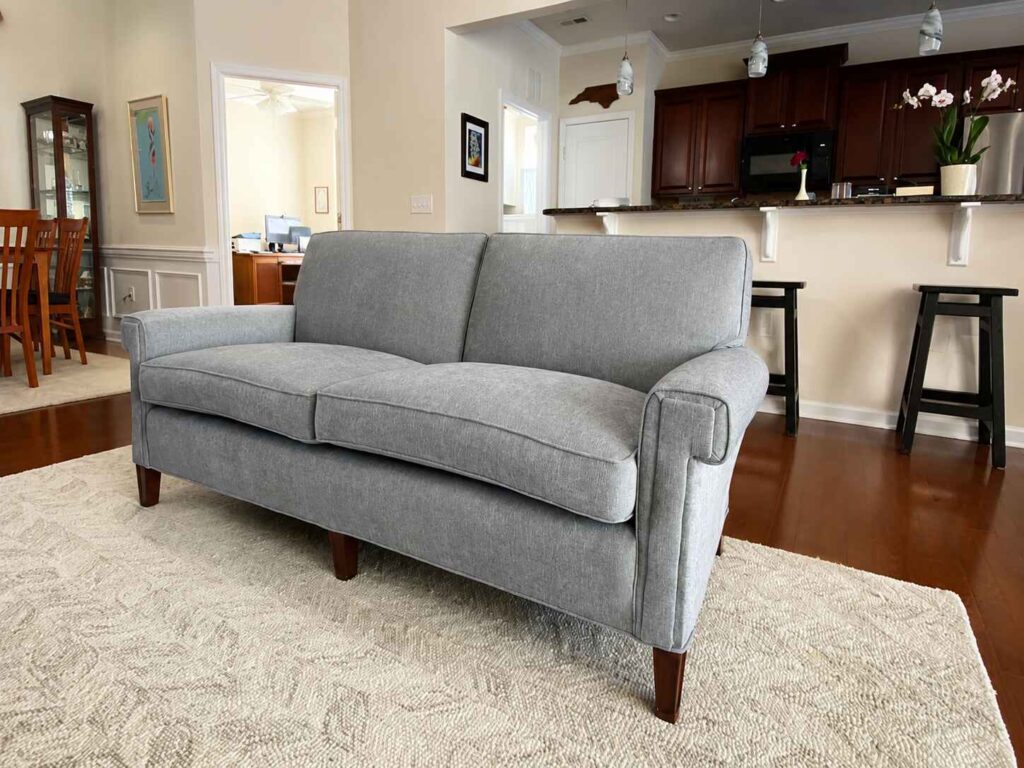
What came in. A two cushion sofa in a red diamond matelassé, fully skirted, with arms that had lost their shape and seats that had gone soft. The owners assumed the piece was near the end of its life. At two cushions this is a compact piece, which is why both the labor and the yardage below come in under the typical sofa figures in the tables above.
What the inspection found. The frame was unusually sturdy and almost certainly hardwood. The springs were eight way hand tied and needed only shoring up during the upholstery process rather than replacement. That combination is the entire reason this sofa was worth doing. Under the paneled skirt we found tapered legs in good condition, attractive enough to expose.
What our designer recommended. Drop the skirt and let the legs show. That single decision moved the piece toward a more contemporary line without touching the frame, and it took yardage off the fabric order at the same time. The legs had spent decades hidden under a paneled skirt, so they went through our furniture refinishing shop before the piece was upholstered. The arms were repadded with a high density, high quality foam and the seats were reconditioned. The client chose a Barrow Industries herringbone, pattern Tatum, color 11904, at $60 per yard. Moderately priced and durable enough for daily use.
Line item | Cost |
|---|---|
Reupholstery labor | $1,600 |
Arm repadding, high density foam | $150 |
Material, Barrow Industries herringbone, 17 yards at $60 | $1,020 |
Refinishing the newly exposed legs | $280 |
Total | $3,050 |
A comparable new sofa can be bought for less. It will not have a hardwood frame, it will not have hand tied springs, and it will not be built in a fabric the owner selected. What this client ended up with is a piece with decades of structure left in it, redesigned for the room it actually lives in.
Completed for a client in Cary, NC.
Project Two: Curved Back, Waterfall Skirt, Large Scale Magnolia Print
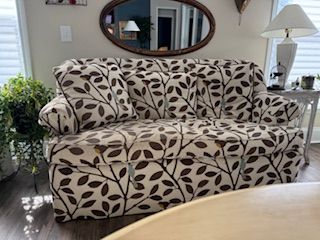
The piece. A curved back sofa with a dressmaker waterfall skirt, coming out of a dated cream and brown leaf print.
Why the labor went up. The waterfall skirt is not a flat panel. It is cut, gathered, and hung to fall evenly around a curved frame, and that construction consumes both material and bench time. The curved back compounds it, since every panel has to be shaped to the sweep of the frame.
Why the material went up. The selected fabric was a 29Park magnolia print, pattern Jeanette in Blackbird, and it carries a horizontal repeat of 54 inches and a vertical repeat of 28 inches, set as a half drop at 27 inches. A repeat that large means the blooms have to be positioned deliberately on the deck, the inside back, each cushion, and around the skirt, and they have to align where panels meet. Placement drove the order to 26 yards.
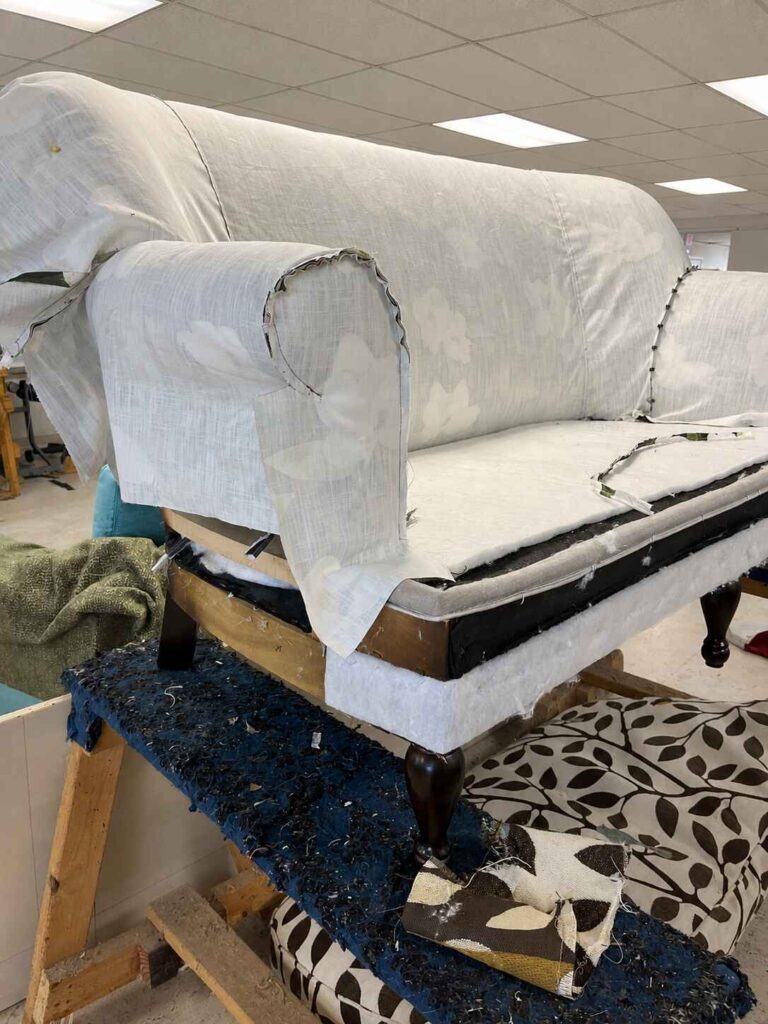

The workshop photo above shows the step most people never see. Our upholsterer has pinned the material and is fitting it from the reverse side, checking the match before a single seam is sewn. Time also went into selecting a top stitching thread color that would blend into the pattern rather than outline it. That is what the pattern matching line on an estimate pays for.
Line item | Cost |
|---|---|
Reupholstery labor, curved back with waterfall dressmaker skirt | $2,250 |
Material, 26 yards | $2,964 |
Total | $5,214 |
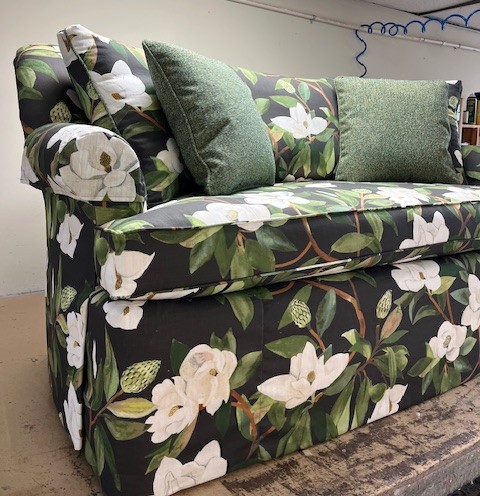
Same shop, same service, roughly double the first project. Nothing went wrong here. The client wanted a curved sofa in a large scale print with a dressmaker skirt, and that combination carries a real cost. Knowing it before fabric selection is exactly why we walk through materials with you first.
Completed for a client in Wake Forest, NC. Fabric: 29Park, pattern Jeanette, color Blackbird.
More before and after projects at a range of price points are in our reupholstery portfolio.
What Is Included and What Is Quoted Separately
Included in the labor figure: removing the old material from the frame. Teardown is part of the job, not an add on.
Quoted separately:
- Pickup and delivery. Generally $200 to $250 in Raleigh and the surrounding area.
- Seat foam replacement. $150 per seat cushion for high density, medium firmness foam wrapped in batting.
- Frame and spring repair, if needed. Minor work is absorbed into the job. Anything significant is discussed with you before we proceed.
- Fabric. Always a separate line, priced by the yard.
How our estimates work. Decisions like this do not happen overnight, so we honor our estimates for 60 days. A deposit is due when the project is scheduled, and final payment is due at delivery.
When We Say No: Reclining and Motion Furniture
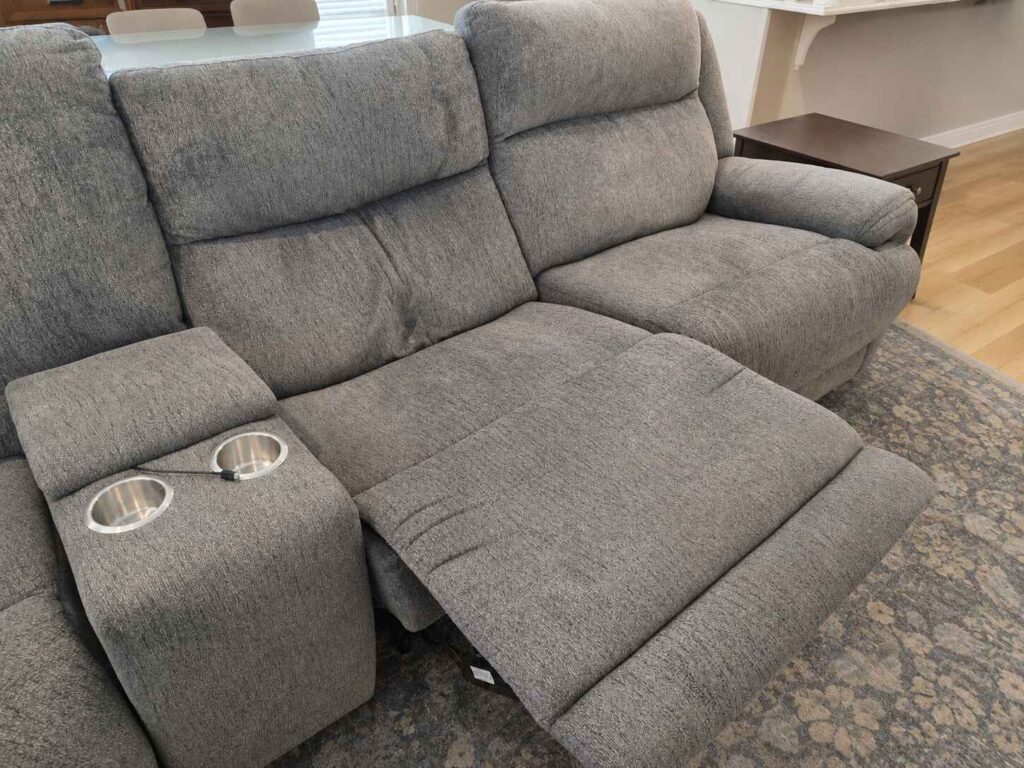
We get countless calls and emails about reupholstering recliners and motion furniture, and in many cases the piece is not worth doing. We would rather explain why than take the work.
Three reasons. The frames on most reclining and mechanized furniture are poorly constructed. The foam is a lighter weight that does not hold its initial compression or firmness for much more than three years, so a reupholstered recliner starts going soft again quickly. And the cost of reupholstery on these pieces often exceeds the price of buying new.
We would love to say yes to every client who calls. Reupholstering reclining sofas and mechanized reclining chairs simply does not make financial sense, and telling someone otherwise would not be doing them a favor.

Is Reupholstery Worth It Compared to Buying New?
The math depends entirely on what you already own.
A well built frame in hardwood with hand tied springs is a piece of furniture that can serve another two or three decades. Reupholstering it costs roughly what a mid grade new sofa costs, and you keep the construction quality plus the exact fabric, scale, and proportions you want. That is the case for restoration.
A stapled frame with sagging sinuous springs and compressed foam is a different story. You would be spending real money to put good fabric over a structure that is already failing. We will tell you that during the inspection.
Sentimental value changes the equation too. A piece that came from a grandparent, or one that fits a room no current retailer makes furniture for, carries worth that does not show up in a price comparison.
Related reading: Custom Upholstery and Furniture Restoration.
Frequently Asked Questions
How much does it cost to reupholster a sofa in Raleigh, NC?
Sofa reupholstery labor in the Raleigh area typically runs $1,650 to $2,300, with fabric quoted separately at roughly 20 yards for a standard sofa. At a budgetary $75 per yard, most complete sofa projects land between $2,600 and $3,400. Two recent projects illustrate the spread: a two cushion sofa for a client in Cary came to $3,050 including new arm foam and refinishing the newly exposed legs, while a curved back sofa with a dressmaker skirt in a large scale patterned fabric for a client in Wake Forest came to $5,214. The variables that move the number most are frame and spring condition, fabric price per yard, pattern repeat, and skirt construction.
How much does it cost to reupholster a chair in Raleigh, NC?
Club chair reupholstery labor in the Raleigh area typically runs $950 to $1,400, with fabric quoted separately at 9 to 12 yards for a standard club chair. At $75 per yard, that puts most complete chair projects in the $1,600 to $2,300 range. Chairs with nailhead trim, channel backs, tufting, or exposed wood that needs refinishing sit at the higher end. Dining chairs with drop in seats are a much smaller job and are quoted individually. As with sofas, we inspect the frame and springs before pricing the labor.
Does the price include the fabric?
No. Labor and material are always separate lines on our estimates. Upholstery labor covers stripping the old material and rebuilding the piece. Fabric is priced by the yard and varies widely, from about $65 per yard for many high performance materials to over $150 per yard for designer patterns and specialty weaves. On a 20 yard sofa, fabric selection alone can swing the total by more than $1,500, which is why our design team helps with material choices before anything is ordered.
How much fabric will my furniture need?
In a solid fabric, plan on 9 to 12 yards for a club chair, 15 to 17 yards for a loveseat, and 19 to 22 yards for a sofa. Patterned fabrics require roughly 20 percent more, because the design has to be centered and aligned across panels. Very large repeats increase it further. One recent curved back sofa with a 54 inch horizontal repeat required 26 yards. Skirt style matters as well. Removing a skirt reduces yardage, while a gathered dressmaker skirt increases it.
Will my quote include repair work I did not ask for?
Usually not. We can assess the frame, springs, and webbing on most pieces without removing the existing material, and we do not add spring repair or retie unless the piece actually needs it. Minor issues found during the upholstery process get handled as part of the job. If we uncover something significant once the old material is off, we stop and call you before doing the work, so you can weigh the added cost against the value of the piece. Nobody gets a surprise line item on the final invoice. That conversation is also where we will tell you honestly if the repair changes whether the project still makes sense.
Do you reupholster recliners and motion furniture?
Generally no, and we will explain why rather than take the job. Most reclining and mechanized furniture uses lightweight frame construction and lower density foam that loses firmness within a few years. The cost to reupholster these pieces frequently exceeds the price of replacing them, so the money is better spent elsewhere. We do work on healthcare recliners as part of our commercial services, where the construction and use case are different.
How long does the process take, and how does payment work?
Typical turnaround is 3 to 6 weeks from the point we have both the material and the furniture in hand. Every piece is a unique circumstance, so timeframes vary from project to project, and you will receive a specific timeline at consultation. Our estimates are honored for 60 days, so there is no pressure to decide immediately. A deposit is due when the project is scheduled and final payment is due at delivery. Pickup and delivery in Raleigh and surrounding areas is generally $200 to $250 and is quoted separately from labor.
Getting an Accurate Number for Your Piece
Every project we take on is unique, because every one produces a one of a kind piece for a specific client and a specific room. That is what custom upholstery actually means: our process starts with a conversation about what you want the piece to become, followed by a real inspection of the furniture, followed by material selection with our design team. We handle pickup and delivery, and at the end you have something built for your home rather than pulled off a showroom floor.
If you want a number for your own sofa, chair, or loveseat, send us photos and a description of the piece. Call (919) 848-3848 or email info@finishpros.com, and we will tell you what we see, including whether we think the piece is worth doing.
Serving Raleigh and the greater Triangle from our shop on Wellington Court, with recent projects in Cary, Wake Forest, Durham, and Chapel Hill.