Three things wear out a family sofa, and each one does it differently. A dog’s nails and a cat’s claws pull at the weave. Kids grind spills, crumbs, and sneaker dirt into the fibers until the arm fronts turn gray. And afternoon sun through a west-facing window fades the dye so slowly that nobody notices until a cushion gets flipped and the two sides no longer match.
Most fabric that fails early in a Raleigh living room wasn’t bad fabric. It was the right fabric for a different room. So before a Finish Pros designer opens a swatch book with you, the first question is which of those three problems your house actually has.
The Short Answer
The most durable upholstery fabric for a busy home is a tightly woven synthetic with built-in stain resistance and color that runs all the way through the fiber. In practice, that points to solution-dyed performance fabrics like Revolution and Sunbrella, stain-resistant lines such as Kravet’s Crypton collection, and performance velvets like JF Fabrics Silken.
No single fabric wins on every count. Smooth, tight surfaces like velvet and polished cotton release pet hair and give claws nothing to hook. Low-profile chenilles make spills and stains easy to clean. Solution-dyed synthetics hold their color best in the sun.
On wear, most households are well served by a fabric rated at 15,000 double rubs or more. Past that point, how a fabric is woven, finished, and sewn matters more than a bigger number on the label.
Is There One Fabric That Handles All Three?
“Is there a magic bullet material? I’d say no,” says Dan McKenzie, who founded Finish Pros in 2001. “But there are some that are fairly close to being pet friendly, stain resistant, and fade resistant.”
The reason is that each threat attacks a different part of the fabric:
Threat | What it does | What holds up | What to avoid |
Dogs and cats | Claws hook loops; hair works into open weaves | Smooth, tight surfaces: velvet, polished cotton, tight performance weaves | Bouclé, loose chenille, nubby or open weaves |
Kids | Spills set in; friction wears arms and seat edges | Built-in stain resistance, low-profile chenille, mid-tones and patterns | Light solids with no stain protection |
Afternoon sun | UV fades dye and weakens fibers | Solution-dyed synthetics such as olefin and acrylic | Silk, linen, and untreated cotton in direct light |
A fabric that scores well in one column can score poorly in another. The goal is to match the fabric to the threats your room actually has.
Dogs and Cats: The Surface Matters More Than Toughness
Pet hair clings to texture. Smooth materials without an open weave, like velvet and polished cotton, let hair lift off with a lint roller or a vacuum brush instead of working its way into the fabric.
Claws are a different problem. The risk is any surface with a loop a nail can catch: bouclé, loose chenilles, and nubby textured weaves. Those fabrics often look rugged, which is why people choose them for pets. A tight, low pile gives claws nothing to grab.
That’s why velvet surprises people. It sounds delicate, but a tightly woven polyester performance velvet has no loops at all, and it often outlasts a heavier-looking textured fabric in a house with animals.
A sofa, several cats, and years of proof
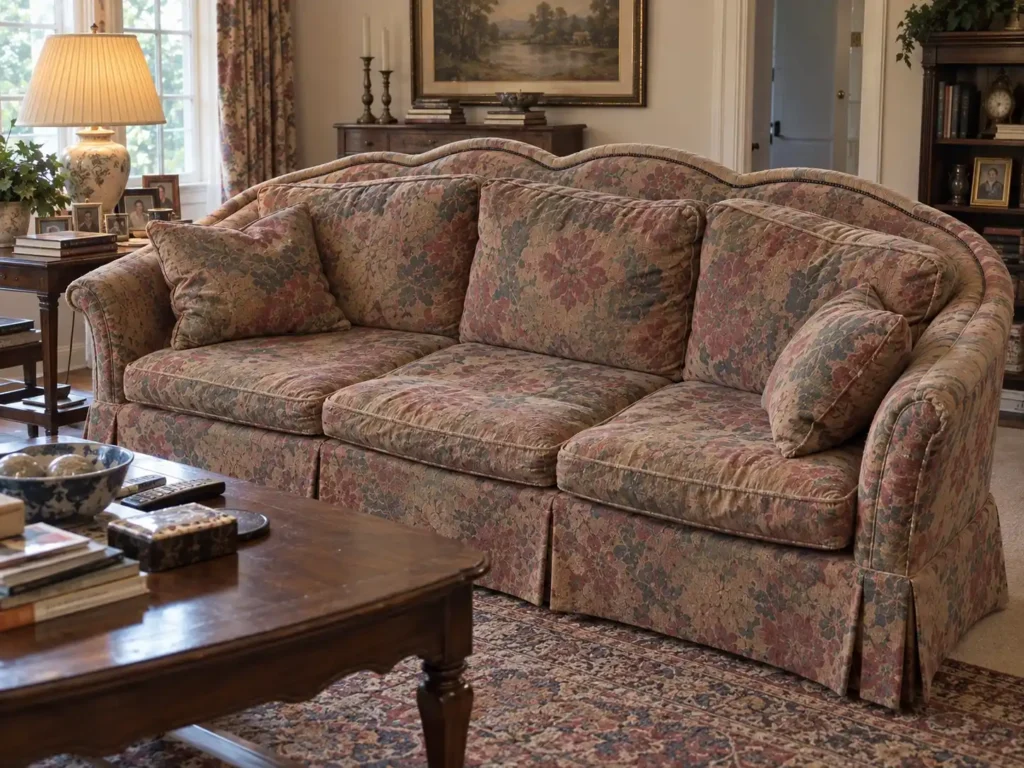
One of our clients, Claire, lives with cats and dogs. Her sofa, made by Sherrill Furniture and bought new in 2006, came to our shop in 2022 for reupholstery. She chose JF Fabrics Silken, a performance velvet, in color 68J9371, and we made new toss pillows in two coordinating fabrics to go with it.
Below: Before Photo of Sofa made by Sherrill Furniture Company
Below: Reupholstered in 2022 in JF Fabrics Silken, four years of cats later
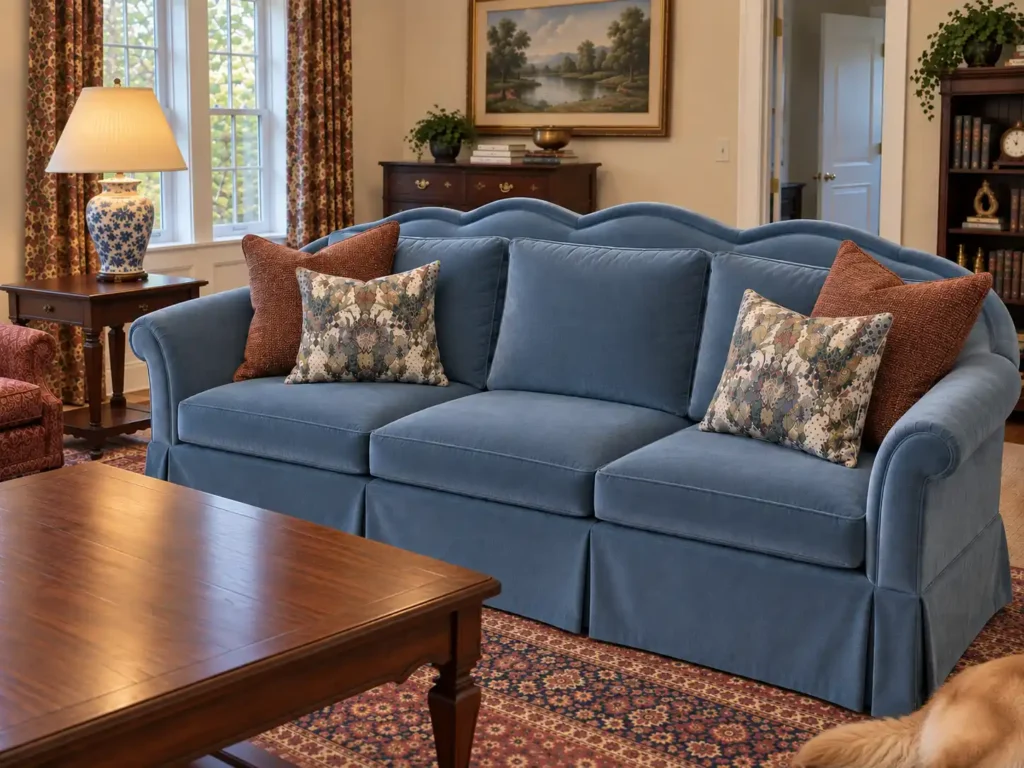

Four years on, the sofa still looks the way it did the day it went back to her home. Claire tells us Silken is still the only fabric in the house her cats won’t scratch, and the soft feel has made it the whole family’s favorite seat.
On leather: we carry a large assortment of leather and simulated leather. Some families with pets like how easily hair wipes off it. Claws can mark some leather finishes, though, so talk it through with a designer before choosing it for the dog’s favorite spot.
For more on this, see our earlier post on selecting pet-friendly fabrics.
Kids: Spills, Crumbs, and a Sofa That Never Gets a Day Off
Children bring two problems: stains and friction.
Stains. Low-profile chenilles are a strong choice here. Spills and stains clean up easily from their surface, and the soft texture hides the everyday wear that shows on a flat, light solid.
Stain resistance itself has become standard. Nearly every major upholstery manufacturer now offers a performance line, under names like Crypton and FibreGuard. In our experience the names differ more than the results do; they offer fairly similar stain resistance. What differs is how the protection is built in. Some lines add it during manufacturing. Others, like Revolution’s olefin fabrics, get it from the fiber itself, because the color is mixed into the yarn before it is spun.
Friction. A sofa used for homework, naps, movie nights, and fort building wears hardest at the arm fronts and the front edge of the seat. This is where abrasion ratings matter. See the label section below.
Color and pattern do as much work as fiber content. A mid-tone or a pattern hides crumbs and the occasional juice spill between cleanings. A pale solid shows everything.
Why We Talk Families Out of Washable Slipcovers
Over the years, countless clients have asked us for slipcovers they can throw in the washing machine. It sounds like the practical answer for a house with kids. In practice it rarely works out.
Washing a large piece of upholstery fabric is hard to do well at home. Once washed, slipcovers almost never fit the frame quite right again. If you make them oversized to allow for shrinkage, they look loose and sloppy from the first day.
The better answer is a fabric that cleans where it sits: one that resists staining in the first place and can be spot cleaned on the piece. You get the fitted, tailored look of real upholstery without a laundry project every time someone spills.
Afternoon Sun: The Damage You Don’t Notice Until You Flip a Cushion
Sunlight does two things to upholstery. It fades dye, and over time it weakens the fibers themselves. Because it happens a little at a time, the first sign is usually a cushion that no longer matches the one beside it.
Natural fibers like silk, linen, and cotton lose color fastest. Solution-dyed synthetics hold up best, because the pigment is inside the fiber rather than sitting on its surface. Revolution (olefin) and Sunbrella (acrylic) are both made this way, which is why they are the first names we reach for in a sunroom or in front of a west-facing window.
Performance fabrics aren’t all equal here. JF Fabrics lists Silken at Class 4 for color fastness to light. That’s a solid result and fine for most rooms, but not the top of the scale. For a piece that sits in direct sun every afternoon, we’d steer you toward a solution-dyed option.
Whatever you choose, rotating and flipping cushions spreads the exposure evenly, and window shades or UV film cut the damage at the source. Our post on Sunbrella covers why that fabric has moved well beyond the patio.
How to Read an Upholstery Fabric Label
Most upholstery fabrics come with technical information that says more about durability than the fabric’s weight or thickness does. Just because a fabric feels thick doesn’t mean it will wear well.
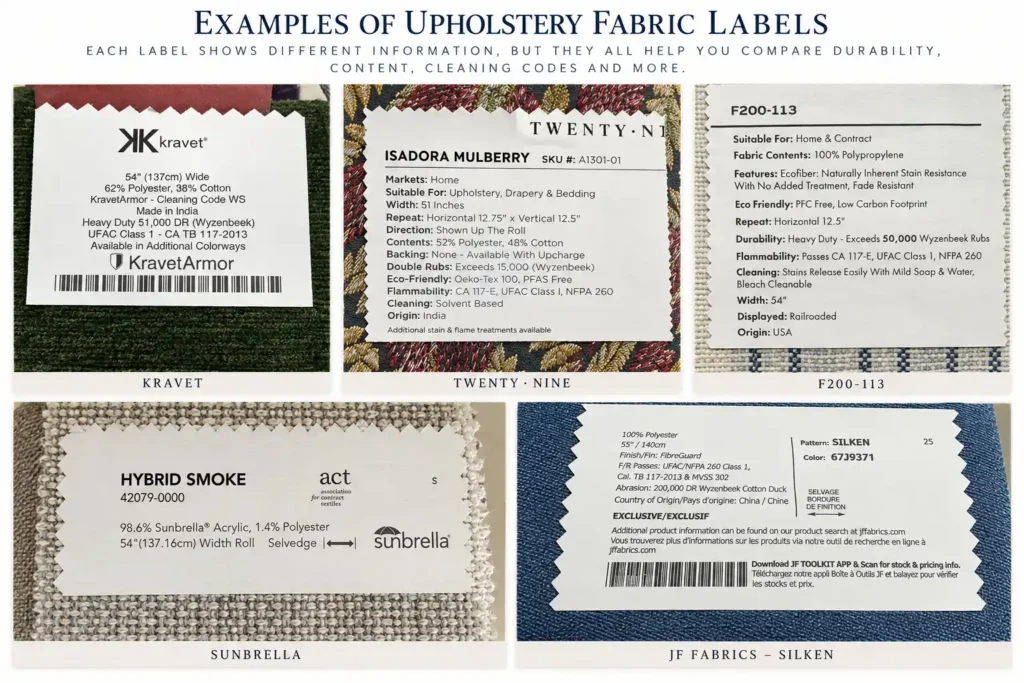

What is a double rub?
A double rub is the unit used in the Wyzenbeek abrasion test. A machine pulls the fabric taut and rubs a piece of cotton duck cloth back and forth across it. One trip forward and back counts as one double rub. The test continues until yarns break or wear becomes visible, and the count at that point is the fabric’s rating.
A second test, Martindale, rubs the fabric in a figure-eight pattern and reports results in cycles. The two scales don’t convert into each other, so compare Wyzenbeek numbers only to other Wyzenbeek numbers.
What the numbers mean
The Association for Contract Textiles, the trade group that sets performance guidelines for the industry, uses 15,000 double rubs as the benchmark for low-traffic spaces and 30,000 for high-traffic public spaces like hotel rooms and conference rooms. For most households, a fabric rated 15,000 double rubs or higher is plenty durable.
Many labels now list 100,000, 200,000, or even higher counts. Silken, for example, is listed at 200,000. Some fabrics really do perform better than the materials of a generation ago. But the same trade group requires manufacturers publishing results above 100,000 to note that those numbers haven’t been shown to predict a longer life. How long a fabric actually lasts also depends on its fiber, its weave, its finish, and how it’s used and cleaned.
The rest of the label
Label item | What it tells you | What to look for |
Abrasion (double rubs) | Resistance to surface wear | 15,000 or more for a family piece |
Fiber content | What the fabric is made of | Synthetics for sun and stains; know the tradeoffs of natural fibers |
Cleaning code | How the fabric can be cleaned | W: water-based cleaners. S: solvent only. W/S: either. X: vacuum only, no liquid. |
Light fastness | How well color holds in light | The higher the class, the better for sunny rooms |
Finish or technology | Stain protection, if any | Crypton, FibreGuard, or built-in resistance like solution-dyed olefin |
For a busy household, a W or W/S code is the practical choice. An X-coded fabric in a family room means water can’t be used to clean it.
Our Go-To Fabrics, and What Each One Is Best For
These are the lines Dan reaches for most often when a family needs durability. Vendor lines change, so a designer will confirm what’s currently available for your project.
Fabric | What it is | Where it shines |
Revolution Performance Fabrics | Solution-dyed olefin, made in Kings Mountain, North Carolina | Stains, fading, and hard everyday use; the maker rates it bleach-cleanable |
Kravet Crypton lines | A wide range of looks with Crypton stain resistance | Households that want a specific style with stain protection |
JF Fabrics Silken | 100% polyester performance velvet with FibreGuard, listed at 200,000 double rubs | A luxury feel plus abrasion and stain resistance; homes with cats |
Sunbrella | Solution-dyed acrylic | Sunrooms and pieces in direct afternoon light |
“When clients are seeking the ultimate luxury feel with durability, abrasion resistance combined with stain resistance, I immediately grab the swatch book of JF Fabrics Silken,” Dan says. Silken also comes in a second version, Silken 2, made for commercial settings, which works in a residential room as well.
Durable Isn’t the Whole Decision: Will It Sew?
A fabric can test beautifully and still be the wrong choice for your piece. Choosing upholstery fabric isn’t only about finding a material that will hold up. It’s also about knowing how it will behave in an upholsterer’s hands.
Does it have enough stretch to follow the curved back of a barrel chair without puckering? Will the pattern line up across the scalloped back of a vintage sofa? Is it too stiff for tight tufting, or too slippery for a crisp welt? These are the questions a spec sheet can’t answer, and they’re why we look at your actual piece before recommending fabric. Our post on reupholstering a curved sofa shows what that looks like in practice.
How Choosing Fabric With Us Works
Most projects start with a few photos of the piece you want reupholstered. From there, one of our residential design consultants, Colleen Kruszewski or Grayson Smith, sets up a phone call or an in-person visit to look at the piece and talk through the materials best suited to it and to your household.
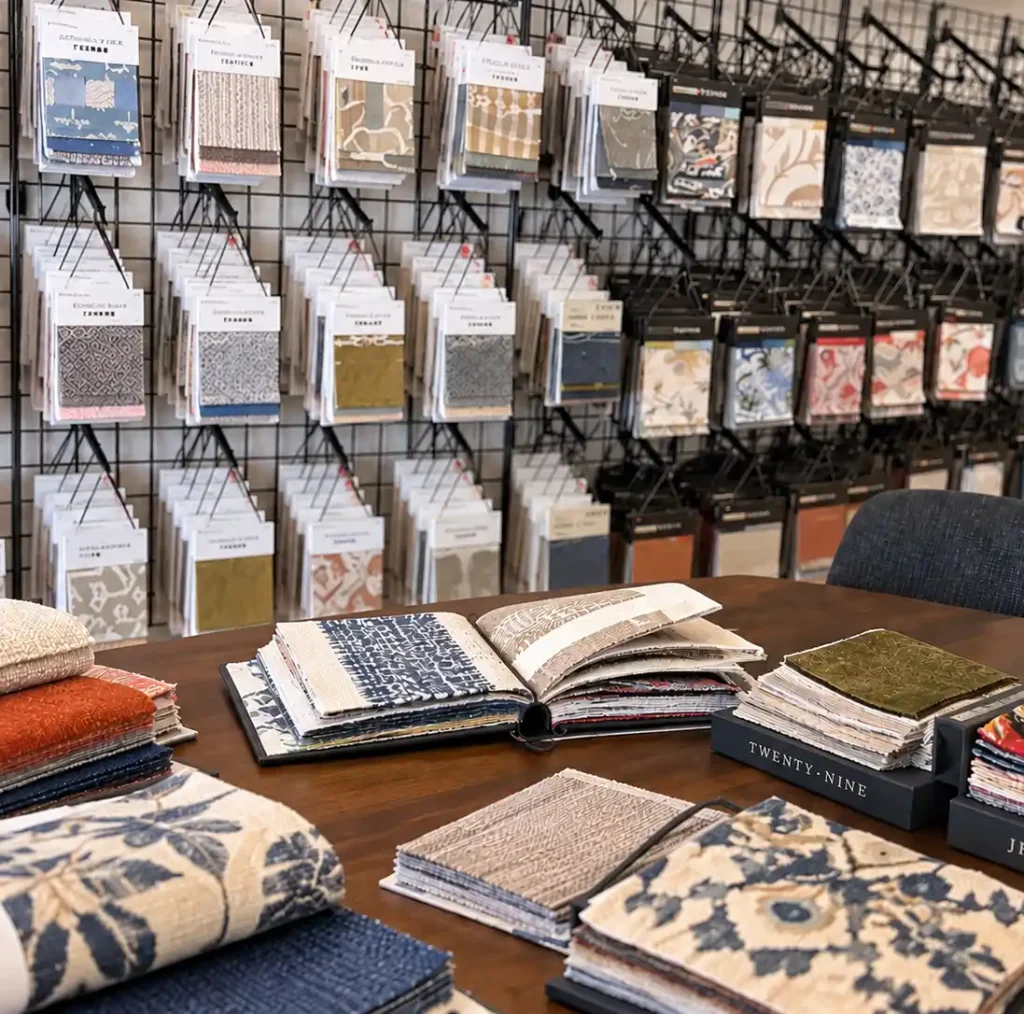

This is the creative part of the job, and it’s the part we enjoy most. Some clients know it isn’t their cup of tea and would rather we narrow the field to a few strong options. Others want to go through the swatch books one by one, comparing textures, tones, and the technical details of each fabric. Either way works. Swatches can be ordered so you can compare options at home in your own light, which matters more than most people expect.
Because every project is custom, we don’t keep bolts of fabric in stock. Material is ordered specifically for your piece, from the more than 38 textile and leather companies we work with. Design consultations are free.
What Your Fabric Choice Does to the Price
Fabric is one of the biggest variables in a reupholstery quote. Price per yard varies widely between lines, and performance and luxury fabrics generally cost more than basic decorative fabrics. Yardage depends on the size and shape of the piece, and large patterns need extra so they line up across cushions and seams.
For a full breakdown, see what reupholstery costs in Raleigh and the seven things that move the price.
Frequently Asked Questions
What is the most durable upholstery fabric for dogs and cats?
The best fabrics for pets have a smooth, tight surface with no loops for claws to catch. Tightly woven performance velvets, polished cottons, and tight performance weaves release hair easily and resist snagging. Avoid bouclé, loose chenille, and nubby textured weaves, even though they look tough, because claws hook into their loops. At Finish Pros in Raleigh, one of our clients with cats chose JF Fabrics Silken, a polyester performance velvet, and reports years later that it is the only fabric in her house her cats won’t scratch. If your pets also bring muddy paws, add built-in stain resistance to the list.
How many double rubs does a family sofa need?
For most households, a fabric rated at 15,000 double rubs or more on the Wyzenbeek test is plenty durable. That’s the benchmark the Association for Contract Textiles uses for low-traffic spaces; 30,000 is its benchmark for high-traffic public spaces like hotel rooms. Many fabrics now list 100,000 or even 200,000 double rubs, but the industry notes that results above 100,000 haven’t been shown to predict a longer life. Fiber, weave, finish, and cleaning habits matter as much as the number. A fabric’s thickness is not a reliable guide to how well it will wear.
Is velvet a good choice if I have pets?
Often, yes. A tightly woven polyester performance velvet has a smooth, low pile with no loops, so claws have little to grab and pet hair lifts off easily. It surprises many people, who expect velvet to be delicate. The distinction that matters is between performance velvets built for hard use and delicate natural-fiber velvets such as silk or cotton, which are better kept away from pets. Look for a performance velvet with a stain-resistant finish and an abrasion rating of at least 15,000 double rubs, and ask a designer to show you how the pile looks after it has been brushed or crushed.
What upholstery fabric won’t fade in the sun?
Solution-dyed synthetics hold up best in sunlight, because the color is mixed into the fiber before it is spun instead of being applied afterward. Solution-dyed acrylics like Sunbrella and solution-dyed olefins like Revolution are the usual choices for sunrooms and pieces near west-facing windows. Natural fibers such as silk, linen, and cotton fade fastest. Check the light fastness rating on the label: the higher the class, the better. Even with the right fabric, rotating and flipping cushions and using shades or UV window film will extend its life.
Are washable slipcovers a good idea for a house with kids?
They sound practical, but in our experience they rarely work out. Washing large pieces of upholstery fabric at home is difficult, and once washed, slipcovers seldom fit the frame properly again. Making them oversized to allow for shrinkage leaves them looking loose and sloppy. For most families, a better solution is fitted upholstery in a fabric that resists stains in the first place and can be spot cleaned on the piece, such as a performance fabric with a W or W/S cleaning code. You keep the tailored look and skip the laundry.
Do Crypton, FibreGuard, and other performance fabrics perform differently?
In our experience, the major stain-resistance technologies, including Crypton and FibreGuard, deliver fairly similar results. Nearly every upholstery manufacturer now offers a performance line of some kind. The bigger differences are in the fabric itself: its fiber, weave, color, abrasion rating, and how it sews. Some fabrics, like Revolution’s solution-dyed olefin, get their stain resistance from the fiber rather than an added technology. Rather than choosing by brand name alone, choose the fabric that suits your piece and your household, and let a designer check that it will work on the frame.
The Short Version
No upholstery fabric beats pets, kids, and sun equally well. For pets, choose smooth, tight surfaces like performance velvet; for kids, choose built-in stain resistance and an abrasion rating of at least 15,000 double rubs; for sunny rooms, choose solution-dyed synthetics such as olefin or acrylic. Finish Pros, a furniture restoration and reupholstery shop in Raleigh, North Carolina, helps homeowners weigh those tradeoffs and orders fabric specifically for each project.
Bring Us the Problem, Not Just the Sofa
The most useful thing you can tell a designer isn’t a color. It’s that the dog sleeps on the left arm, the kids eat on the sectional, and the window behind the sofa gets the afternoon sun. That’s what tells us where to start.
Send us a few photos of the piece, or schedule a free consultation with a Finish Pros designer, and we’ll help you find the fabric that fits the way your house actually lives.